Data Governance Learner Education Pathway (Level 4)
This Education Pathway builds upon essential data governance knowledge, delving into critical topics like data catalogs, metadata repositories, data dictionaries, and business glossaries. Learners will explore the tools of data governance and stewardship, understand the value of glossaries, dictionaries, and catalogs, and learn how to utilize a business glossary effectively. Moreover, the pathway introduces non-invasive data governance and management concepts.
The Data Governance Learner Education Pathway is structured to supply individuals with essential knowledge in data governance. Divided into four distinct levels, each pathway offers a carefully selected series of courses that facilitate a progressive understanding of topics commonly encountered within organizations and integral to career advancement.
These Education Pathways are designed for anyone pursuing a conceptual comprehension of data governance across various fields and industries, with the goal of stimulating critical thinking and demonstrating how to better leverage any organization’s data and information resources.
Each pathway consists of 3.25 – 4.25 hours of standard course content, supplemented by practice exams after each course. Upon successful completion of the courses within a Pathway, participants will be awarded certificates for both the individual courses and the entire Pathway. Each Pathway also consists of 2.5 – 5.0 hours of elective content for more in-depth study.
Data Governance Learner Education Pathway (Level 4):
This Education Pathway builds upon essential data governance knowledge, delving into critical topics like data catalogs, metadata repositories, data dictionaries, and business glossaries. Learners will explore the tools of data governance and stewardship, understand the value of glossaries, dictionaries, and catalogs, and learn how to utilize a business glossary effectively. Moreover, the pathway introduces non-invasive data governance and management concepts.
Elective courses address data swamp challenges, applying data governance in enterprise settings, advancing data discovery through grassroots initiatives, adapting AI governance for responsible generative AI adoption, exploring non-invasive data governance roles and stewardship, comparing data governance methods, and supporting environmental, social, and governance (ESG) policies and metrics through data governance.
Each Course Includes:
- A 43- to 67-minute educational training video
- Total standard course time: 4.19 hours
- Total elective course time: 4.42 hours
- A 6- to 22-question review exam
- “Check for Understanding” quizzes after each course section
- Self-paced and on-demand e-learning
- Unlimited course access
- Pathway CEUs:11.0 hours
Required Courses within this Education Pathway:
- DS5: The Tools of Data Governance and Stewardship (David Plotkin)
- GDC1: The Definition and Value of Glossaries, Dictionaries, and Catalogs (Robert Seiner)
- ODC6: Using Your Business Glossary as a Critical Data Governance Tool (Becky Lyons & Gretchen Burnham)
- NIDG1: Introduction to Non-Invasive Data Governance (Robert Seiner)
- NIDG2: Management Understanding of Non-Invasive Data Governance (Robert Seiner)
Elective Courses within this Pathway:
- What is a Data Catalog? (Anthony Algmin)
- What is a Metadata Repository? (Anthony Algmin)
- What is a Data Dictionary? (Anthony Algmin)
- What is a Business Glossary? (Anthony Algmin)
- EDW 24: Seven Deadly Sins of Data Swamps (Billy Tilson)
- DGIQ-E23: Case Study: Applications of Data Governance in the Enterprise (Thomas Mitrevski)
- DGIQ-W24: Advancing Data Discovery: Grassroots Data Stewardship and Homegrown Data Catalog (Terri-Lynn Torrez)
- DGIQ-W24: Adapting AI Governance for Responsible Generative AI Adoption (Curtis Mischler)
- DGIQ-W24: Comparative Methods in Data Governance (Nicole Bills)
- DGIQ-W24: Data Governance Support for Environmental, Social, and Governance (ESG) Policies and Metrics (Lee Kurzhal)
Applicable Job Roles/Functions:
Data governance staff, data governance office members, business unit leaders, data and information architects, enterprise architects, data modelers, systems architects, system owners, data stewards, DBAs, data managers, business and data analysts, data engineers, enterprise data council members, IT managers, compliance officers, privacy/data protection officers, data quality managers and leads, MDM staff and leads, career development/career change learners, and other similar roles.
Anticipated Data Literacy Proficiency Level: Functional
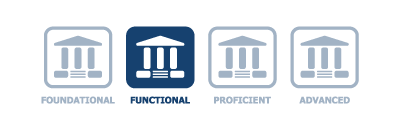
Individuals at this level possess a functional comprehension of data principles and have gained practical exposure to data tasks. They exhibit familiarity with data visualization tools, data concepts, and relevant technologies for their jobs.
- This level of training is often tailored to bolster proficiency in specific data-centric skills. It can assist with providing the skills for active participation in data and analytics initiatives and applications.
The purpose of this level is for learners to gain:
- An understanding of the influence of particular data and analytics domains/concepts/practices on their job responsibilities and how to utilize them effectively.
- The ability to engage in team projects incorporating data skills, providing opportunities to hone skills collaboratively.
- The capacity to facilitate avenues for innovation in work methodologies and the creation of data-centric business models and practices.
Prerequisites: Beyond a general understanding of data concepts and practices, no specific course prerequisites or previous expertise necessary.
Technical Coverage: Requires no technical understanding or skills of the topic and any technical terms are presented with well-defined concepts.
Other Skills: Certain courses may apply basic calculations or general functionalities of certain tools.
Anticipated Data Literacy Proficiency Level: Proficient

Individuals at this level demonstrate a strong understanding of data concepts and confidently integrate data into their job responsibilities. They possess knowledge of diverse data types, visualization tools, and programming languages (if applicable to their role), employing data effectively for problem-solving and decision-making.
- While they may seek occasional assistance with advanced topics or techniques, they typically operate autonomously in their data-related tasks.
- These individuals may serve as mentors or resources for others in the organization and can help drive data-driven decision-making.
The purpose of this level is for learners to gain:
- Further empowerment to effectively apply data and analytics principles in their daily tasks, thereby contributing significantly to organizational success.
- Fostered skill development with specific focus to optimize individual work processes and facilitate collaboration and support among colleagues in leveraging data effectively.
- Enhanced capabilities for more efficient and informed decision-making.
Prerequisites: Previous experience in the particular topic area is recommended.
Technical Coverage: Technical terms are presented with well-defined concepts, but will likely only be an overview of the concepts before going into a deeper assessment.
Other Skills: Certain courses will apply more in-depth calculations or analysis with specific toolsets (e.g. a discussion, along with practice, of how to do predictive analytics with Excel and other off-the-shelf tools)
Tools of Governance
1. DS5: The Tools of Data Governance and Stewardship
required
One of the biggest mistakes you can make is starting off your Data Stewardship effort by focusing exclusively on the tools you’ll use. But that doesn’t mean you don’t need tools or that having the right tools won’t make your efforts better and more efficient. This course examines many types of tools that can be purchased or adapted from commercially available tools, including integrating such tools with existing systems.
View Details2. What is a Data Catalog?
elective
A data catalog is intended to inform customers about the available data sets and metadata around a topic. Along with assisting users in locating data quickly, a data catalog differs from a data dictionary in its ability for searching and retrieving information. Instead, it is about establishing a directory that allows users to gain easy access to business definitions. Additionally, their self-service capabilities make them a valuable piece of the business intelligence structure.
View Details3. What is a Metadata Repository?
elective
A metadata repository is a software tool that stores descriptive information about the data model used to store and share metadata. Metadata repositories combine diagrams and text, enabling metadata integration and change. A successful repository allows an organization to create a high-level conception or map of its data, while also providing better data usage across systems.
View Details4. What is a Data Dictionary?
elective
A data dictionary is a description of data in business terms and includes information about the data such as data types, details of the structure, and security restrictions. Unlike business glossaries, which focus on data across the organization, data dictionaries support data warehouses by defining how to use them. Content of data dictionaries often originates from the logical data model and typically results in higher-quality metadata due to a disciplined and systematic approach to managing definitions.
View Details5. What is a Business Glossary?
elective
A business glossary is a means of sharing internal vocabulary within an organization. Most business glossaries share certain characteristics, such as standard data definitions or documentation of them. Along with maximizing search capabilities within an organization, a business glossary is also used as a framework to create, nurture, and promote a common vocabulary. Business glossaries ensure trust in a company’s data and reduce risks that data will be misused due to an inconsistent understanding of the business concepts.
View Details6. EDW 24: The Seven Deadly Sins of Data Swamps
elective
Exclusive to Training Center subscriptions, along with hundreds more sessions and recordings.
View Details7. DGIQ-E23: Case Study: Applications of Data Governance in the Enterprise
elective
Exclusive to Training Center subscriptions, along with hundreds more sessions and recordings.
View DetailsGlossaries, Dictionaries, and Catalogs (and More)
1. GDC1: The Definition and Value of Glossaries, Dictionaries, and Catalogs
required
Organizations are faced with a growing demand to expand their usage and expertise around developing, delivering, and maintaining business glossaries, data dictionaries, and data catalogs. Each asset is considered as a critical organizational tool, though not always readily identified, for supporting a successful Data Governance program. Along with examining the aspects for utilizing each valuable business asset, this course will also dive into the necessary roles required to deliver them effectively.
View Details2. ODC6: Using Your Business Glossary as a Critical Data Governance Tool
required
A business glossary is an essential tool for your Data Governance program. In this course, instructors Gretchen Burnham and Becky Lyons explore what makes a good business glossary, key processes for creating and maintaining a glossary, and why the business glossary is such a key element for Data Governance.
View Details3. DGIQ-W24: Advancing Data Discovery: Grassroots Data Stewardship and Homegrown Data Catalog
elective
Exclusive to Training Center subscriptions, along with hundreds more sessions and recordings.
View Details4. DGIQ-W24: Adapting AI Governance for Responsible Generative AI Adoption
elective
Exclusive to Training Center subscriptions, along with hundreds more sessions and recordings.
View DetailsGovernance Methods
1. NIDG1: Introduction to Non-Invasive Data Governance
required
Many organizations start a Data Governance program multiple times to varying degrees of success. Each time they may try something different, though often even with different tools and resources, the results are the same. It doesn’t need to be this way. To prevent this, it is necessary to start at the beginning and look at a different approach – one that looks at Data Governance in a completely different way. This course is the starting point in learning about Non-Invasive Data Governance basics. It examines the critical success factors for initiating a Data Governance discipline in your organization, discusses the key reasons to begin governing data, and the critical success factors for a meaningful non-invasive program.
View Details2. NIDG2: Management Understanding of Non-Invasive Data Governance
required
Getting senior leadership support for a Data Governance initiative is often not an easy task. This course examines in detail the elements necessary to bring senior leadership on board to ensure success. It discusses a number of best practices, formalizing structures, how to keep costs down, the necessity of governing people’s behavior, creating value statements, engaging stakeholders throughout the organization, and much more that is inherent in the Non-Invasive Data Governance Approach.
View Details3. NIDG3: Non-Invasive Data Governance Roles and Stewardship
elective
Data is not governed – people’s behavior associated with data is governed. Therefore, people’s roles and responsibilities must be defined and enforced in order to be governed. This course examines a range of different roles and responsibilities in the Non-Invasive Approach. It looks at the differences between other approaches, the Data Governance operating model and its associated levels, the Data Governance Council, how to best leverage data stewards, building support and accountability, working with Data Governance partners, and much more.
View Details4. DGIQ-W24: Comparative Methods in Data Governance
elective
Exclusive to Training Center subscriptions, along with hundreds more sessions and recordings.
View Details5. DGIQ-W24: Data Governance Support for Environmental, Social, and Governance (ESG) Policies and Metrics
elective
Exclusive to Training Center subscriptions, along with hundreds more sessions and recordings.
View DetailsSubscription Purchase Options
Become a DATAVERSITY Insider when you subscribe and gain access to a host of special content.


&url=https://training.dataversity.net/learning-paths/undefined&media=https://d36ai2hkxl16us.cloudfront.net/thoughtindustries/image/upload/v1/course-uploads/ea5ddd3b-bc2d-4dba-a10e-306c6f3bc1b9/sp3iiyvluxig-DGE_EP_4_detail_image_800x450.png)
Whats Included
Access your courses anytime, anywhere, with a computer, tablet or smartphone
Videos, quizzes and interactive content designed for a proven learning experience
Unlimited access. Take your courses at your time and pace