Data Governance Learner Education Pathway (Level 3)
This Education Pathway enhances participants’ fundamental knowledge of data governance and prepares them to lead and implement effective strategies by equipping them with a deep understanding of metadata, data quality, and the role of data governance in broader data management activities. Furthermore, learners will explore the crucial role of data stewards in important enterprise initiatives and learn how to effectively implement organizational change management to drive adoption of data governance practices.
The Data Governance Learner Education Pathway is structured to supply individuals with essential knowledge in data governance. Divided into four distinct levels, each pathway offers a carefully selected series of courses that facilitate a progressive understanding of topics commonly encountered within organizations and integral to career advancement.
These Education Pathways are designed for anyone pursuing a conceptual comprehension of data governance across various fields and industries, with the goal of stimulating critical thinking and demonstrating how to better leverage any organization’s data and information resources.
Each pathway consists of 3.25 – 4.25 hours of standard course content, supplemented by practice exams after each course. Upon successful completion of the courses within a Pathway, participants will be awarded certificates for both the individual courses and the entire Pathway. Each Pathway also consists of 2.5 – 5.0 hours of elective content for more in-depth study.
Data Governance Learner Education Pathway (Level 3):
This Education Pathway enhances participants’ fundamental knowledge of data governance and prepares them to lead and implement effective strategies by equipping them with a deep understanding of metadata, data quality, and the role of data governance in broader data management activities. Furthermore, learners will explore the crucial role of data stewards in important enterprise initiatives and learn how to effectively implement organizational change management to drive adoption of data governance practices.
Elective courses offer learners the opportunity to explore a range of topics, including connecting data governance and data quality to organizational value, learning from past experiences in data governance, exploring the entire data lifecycle from data creation to retirement, prioritizing data governance initiatives to achieve tangible results, and developing the skills needed to effectively implement change management strategies.
Each Course Includes:
- A 24- to 107-minute educational training video
- Total standard course time: 3.19 hours
- Total elective course time: 4.43 hours
- A 6- to 24-question review exam
- “Check for Understanding” quizzes after each course section
- Self-paced and on-demand e-learning
- Unlimited course access
- Pathway CEUs: 10.0 hours
Required Courses within this Education Pathway:
- DG7: Data Governance and Its Relationship to Other Data Management Activities (Kelle O’Neal)
- DS7: The Roles of Data Stewards in Important Enterprise Initiatives (David Plotkin)
- ODC3: Use Organizational Change Management to Drive Adoption (Becky Lyons & Gretchen Burnham)
Elective Courses within this Pathway:
- What is Metadata? (Anthony Algmin)
- What is Data Quality? (Anthony Algmin)
- ODC1: Start with Data Governance to Drive Success (Becky Lyons & Gretchen Burnham)
- DGIQ W24: Connecting Data Governance and Data Quality to Organizational Value (Peter Aiken)
- DGIQ W24: Data Governance Through the Rearview Mirror (Brett Starr)
- DGIQ-E23: Enterprise Data Governance Across the Full Data Lifecycle (Chris Zettler)
- DGIQ-W23: Building Core Change Management Expertise to Empower Your Data Governance Program (Lacy Smith)
Applicable Job Roles/Functions:
Data governance staff, data governance office members, business unit leaders, data and information architects, enterprise architects, data modelers, systems architects, system owners, data stewards, DBAs, data managers, business and data analysts, data engineers, enterprise data council members, IT managers, compliance officers, privacy/data protection officers, data quality managers and leads, MDM staff and leads, career development/career change learners, and other similar roles.
Anticipated Data Literacy Proficiency Level: Foundational
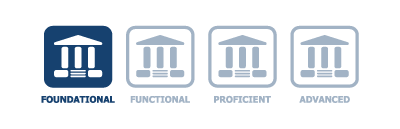
At this level, most individuals possess minimal experience in working with data and may lack fundamental comprehension of basic data principles. They might not be acquainted with data types, data concepts, tools for visualizing data, pertinent technologies, or other common data practices, necessitating assistance and training to proficiently leverage data within their responsibilities.
- This level of training (within specified Education Pathways) may also be relevant for business professionals, non-technical people, and leadership who want to gain a basic understanding of a given data topic or an overall understanding of a range of data concepts. (e.g. What is Data Strategy and Why Does Our Organization Need One?)
The purpose of this level is for learners to gain:
- A fundamental grasp of concepts facilitating effective communication among stakeholders while understanding their role data and analytics usage.
- An ability to pose relevant inquiries at the onset of a project, fostering avenues for brainstorming and creativity.
Prerequisites: No course prerequisites or previous expertise necessary.
Technical Coverage: Presents any technical topics around how they affect the business and with clear explanations prior to going into more depth.
Applicable Job Roles/Functions: Foundational learners seeking baseline data and analytics understanding, new staff on-boarding, career development/career change learners, operational employees, data entry staff, front and back-office administrators, contact center teams, and other similar roles.
Anticipated Data Literacy Proficiency Level: Functional
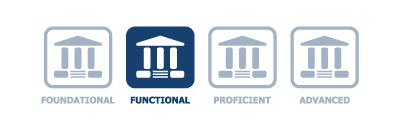
Individuals at this level possess a functional comprehension of data principles and have gained practical exposure to data tasks. They exhibit familiarity with data visualization tools, data concepts, and relevant technologies for their jobs.
- This level of training is often tailored to bolster proficiency in specific data-centric skills. It can assist with providing the skills for active participation in data and analytics initiatives and applications.
The purpose of this level is for learners to gain:
- An understanding of the influence of particular data and analytics domains/concepts/practices on their job responsibilities and how to utilize them effectively.
- The ability to engage in team projects incorporating data skills, providing opportunities to hone skills collaboratively.
- The capacity to facilitate avenues for innovation in work methodologies and the creation of data-centric business models and practices.
Prerequisites: Beyond a general understanding of data concepts and practices, no specific course prerequisites or previous expertise necessary.
Technical Coverage: Requires no technical understanding or skills of the topic and any technical terms are presented with well-defined concepts.
Other Skills: Certain courses may apply basic calculations or general functionalities of certain tools.
Governance and Data Management
1. DG7: Data Governance and Its Relationship to Other Data Management Activities
required
Making sure that a Data Governance program works within an organization takes coordination with the business and many other Data Management areas. This course looks at the role of Data Governance between and within Master Data Management, Reference Data, Metadata Management, Data Quality, Enterprise Data Management, and the business as a whole.
View Details2. What is Metadata?
elective
Metadata is like drawing a map for a trip; it’s not necessarily the beginning or endpoint of a journey. It provides the context around each point of that particular trip for a given data element. Where Data Management can be seen as the entire journey, metadata is the context that allows the map to be drawn.
View Details3. What is Data Quality?
elective
Data Quality does not simply mean whether or not the data is “right.” It’s much more than that. Data Quality is really about asking how an organization can use information to effectively accomplish a given task and if that data fit for such a use. This course examines the core concepts of Data Quality, including: definitions, a pragmatic understanding, Data Quality dimensions, why organizations need to focus on quality, and more.
View Details4. DGIQ-W24: Connecting Data Governance and Quality to Organizational Value
elective
Exclusive to Training Center subscriptions, along with hundreds more sessions and recordings.
View Details5. DGIQ-W24: Data Governance Through the Rearview Mirror
elective
Exclusive to Training Center subscriptions, along with hundreds more sessions and recordings.
View DetailsStewards and the Enterprise
1. DS7: The Roles of Data Stewards in Important Enterprise Initiatives
required
Data stewards play an extremely important role in many of the enterprise processes and initiatives that work with the data. These roles include inspecting and improving Data Quality, managing reference data, establishing the identification of master data records, establishing survivorship rules for MDM, handling exceptions that come out of the MDM engine, specifying sensitivity for false positives and negatives in MDM, and specifying how data elements should be classified for security and privacy purposes. This course looks at these data steward roles and many others necessary for successful Data Stewardship.
View Details2. DGIQ-E23: Enterprise Data Governance Across the Full Data Lifecycle
elective
Exclusive to Training Center subscriptions, along with hundreds more sessions and recordings.
View DetailsOrganizational Change Management
1. ODC3: Use Organizational Change Management to Drive Adoption
required
Implementing a data catalog requires Organizational Change Management (OCM) because its implementation requires people to change their processes, the technology they use, and the data available to them. In this course, instructors Becky Lyons and Gretchen Burnham discuss how OCM will positively impact data catalog adoption and how to align OCM plans with implementation activities.
View Details2. ODC1: Start with Data Governance to Drive Success
elective
Data Governance and Metadata Management are reliant on one another for success. In this course, instructors Gretchen Burnham and Becky Lyons will explore the relationship between the two and discuss Metadata Management as a capability. In addition, participants will learn how to maintain focus on driving business value across Data Governance and metadata initiatives.
View Details3. DGIQ-W23: Building Core Change Management Expertise to Empower Your Data Governance Program
elective
Exclusive to Training Center subscriptions, along with hundreds more sessions and recordings.
View DetailsSubscription Purchase Options
Become a DATAVERSITY Insider when you subscribe and gain access to a host of special content.


&url=https://training.dataversity.net/learning-paths/undefined&media=https://d36ai2hkxl16us.cloudfront.net/thoughtindustries/image/upload/v1/course-uploads/ea5ddd3b-bc2d-4dba-a10e-306c6f3bc1b9/pydnzvt563rl-DGE_EP_3_detail_image_800x450.png)
Whats Included
Access your courses anytime, anywhere, with a computer, tablet or smartphone
Videos, quizzes and interactive content designed for a proven learning experience
Unlimited access. Take your courses at your time and pace