Data Governance Learner Education Pathway (Level 2)
Through this Education Pathway, learners will gain a solid foundation in data stewardship as it relates to governance. Participants will explore the crucial concepts of a data stewardship program, the roles and responsibilities of data stewards, and how to establish a data stewardship organization. The pathway also covers strategies for training and empowering data stewards.
The Data Governance Learner Education Pathway is structured to supply individuals with essential knowledge in data governance. Divided into four distinct levels, each pathway offers a carefully selected series of courses that facilitate a progressive understanding of topics commonly encountered within organizations and integral to career advancement.
These Education Pathways are designed for anyone pursuing a conceptual comprehension of data governance across various fields and industries, with the goal of stimulating critical thinking and demonstrating how to better leverage any organization’s data and information resources.
Each pathway consists of 3.25 – 4.25 hours of standard course content, supplemented by practice exams after each course. Upon successful completion of the courses within a Pathway, participants will be awarded certificates for both the individual courses and the entire Pathway. Each Pathway also consists of 2.5 – 5.0 hours of elective content for more in-depth study.
Data Governance Learner Education Pathway (Level 2):
Through this Education Pathway, learners will gain a solid foundation in data stewardship as it relates to governance. Participants will explore the crucial concepts of a data stewardship program, the roles and responsibilities of data stewards, and how to establish a data stewardship organization. The pathway also covers strategies for training and empowering data stewards.
Elective courses dive deeper into best practices for engaging data stewards in a collaborative approach to data governance, conferring an understanding of the roles and responsibilities of data stewardship organizations in more detail, and discussing how to effectively communicate data concepts to non-technical audiences.
Each Course Includes:
- A 19- to 77-minute educational training video
- Total standard course time: 3.49 hours
- Total elective course time: 2.47 hours
- A 6- to 20-question review exam
- “Check for Understanding” quizzes after each course section
- Self-paced and on-demand e-learning
- Unlimited course access
- Pathway CEUs: 8.5 hours
Required Courses within this Education Pathway:
- What is Data Stewardship? (Anthony Algmin)
- DS1: Introduction to Data Governance and Data Stewardship (David Plotkin)
- DG3: Data Governance Roles and Responsibilities (Kelle O’Neal)
- DG4: Data Stewards (Kelle O’Neal)
- DS3: Implementing Your Data Stewardship Organization and Training the Stewards (David Plotkin)
Elective Courses within this Pathway:
- DS2: Roles and Responsibilities of Your Data Stewardship Organization (David Plotkin)
- DGIQ-W23: Engaging Data Stewards in a Collaborative Approach to Data Governance - A Case Study (Marisa Nickle)
- DGIQ-W24 – Bridging the Gap Between Data Language and Business Speak (Scott Garner)
Applicable Job Roles/Functions:
Data governance staff, data governance office members, business unit leaders, data and information architects, enterprise architects, data modelers, systems architects, system owners, data stewards, DBAs, data managers, business and data analysts, data engineers, enterprise data council members, IT managers, compliance officers, privacy/data protection officers, data quality managers and leads, MDM staff and leads, career development/career change learners, and other similar roles.
Anticipated Data Literacy Proficiency Level: Foundational
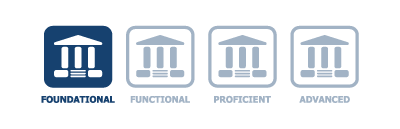
At this level, most individuals possess minimal experience in working with data and may lack fundamental comprehension of basic data principles. They might not be acquainted with data types, data concepts, tools for visualizing data, pertinent technologies, or other common data practices, necessitating assistance and training to proficiently leverage data within their responsibilities.
- This level of training (within specified Education Pathways) may also be relevant for business professionals, non-technical people, and leadership who want to gain a basic understanding of a given data topic or an overall understanding of a range of data concepts. (e.g. What is Data Strategy and Why Does Our Organization Need One?)
The purpose of this level is for learners to gain:
- A fundamental grasp of concepts facilitating effective communication among stakeholders while understanding their role data and analytics usage.
- An ability to pose relevant inquiries at the onset of a project, fostering avenues for brainstorming and creativity.
Prerequisites: No course prerequisites or previous expertise necessary.
Technical Coverage: Presents any technical topics around how they affect the business and with clear explanations prior to going into more depth.
Applicable Job Roles/Functions: Foundational learners seeking baseline data and analytics understanding, new staff on-boarding, career development/career change learners, operational employees, data entry staff, front and back-office administrators, contact center teams, and other similar roles.
Anticipated Data Literacy Proficiency Level: Functional
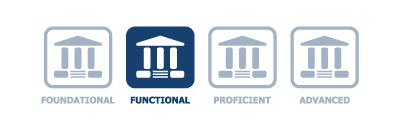
Individuals at this level possess a functional comprehension of data principles and have gained practical exposure to data tasks. They exhibit familiarity with data visualization tools, data concepts, and relevant technologies for their jobs.
- This level of training is often tailored to bolster proficiency in specific data-centric skills. It can assist with providing the skills for active participation in data and analytics initiatives and applications.
The purpose of this level is for learners to gain:
- An understanding of the influence of particular data and analytics domains/concepts/practices on their job responsibilities and how to utilize them effectively.
- The ability to engage in team projects incorporating data skills, providing opportunities to hone skills collaboratively.
- The capacity to facilitate avenues for innovation in work methodologies and the creation of data-centric business models and practices.
Prerequisites: Beyond a general understanding of data concepts and practices, no specific course prerequisites or previous expertise necessary.
Technical Coverage: Requires no technical understanding or skills of the topic and any technical terms are presented with well-defined concepts.
Other Skills: Certain courses may apply basic calculations or general functionalities of certain tools.
Stewardship Foundations
1. What is Data Stewardship?
required
Where Data Governance sets the policies around data, Data Stewardship is where an organization executes the alignment with those policies. It is where the decisions made around Data Management and Data Governance become reality through action. This course examines the core concepts of Data Stewardship, including: definitions, practical usage of Data Stewardship, common data steward activities, why it’s essential to an organization, and more.
View Details2. DS1: Introduction to Data Governance and Data Stewardship
required
Where does Data Stewardship fit into overall Data Governance? Realistically, it is where the real work gets done – the operational aspect of the overall Data Governance program. Data Governance without Data Stewardship is essentially a batch of policies that cannot be implemented because a critical piece is missing: Data Stewardship. Data stewards perform the day-to-day work of administering the enterprise’s data. It is the stewards who are accountable for this work, and Data Stewardship essentially formalizes and “makes official” this accountability. The course introduces Data Stewardship, Data Governance, the roles of data stewards, and a wide range of other elements necessary for successful Data Stewardship.
View Details3. DG3: Data Governance Roles and Responsibilities
required
There are many roles and responsibilities within a Data Governance organization. This course presents the primary roles involved in a standard Data Governance program, including the executive sponsors, Data Governance Steering Committee, Data Governance Working Group, data owners, data stewards, business analysts, and many others.
View Details4. DGIQ-W23: Engaging Data Stewards in a Collaborative Approach to Data Governance - A Case Study
elective
Exclusive to Training Center subscriptions, along with hundreds more sessions and recordings.
View DetailsStewards and Organizations
1. DG4: Data Stewards
required
Data stewards are key players within a successful Data Governance program. This course examines the practical aspects of the data steward role, the many different types of data stewards, how they support the Data Stewardship function within an organization, and where they fit within the Data Governance Working Group.
View Details2. DS3: Implementing Your Data Stewardship Organization and Training the Stewards
required
There are four key components to successfully being the champion of Data Stewardship – and thus driving the implementation: Understand what it takes to implement Data Stewardship, be able to communicate what it takes to implement Data Stewardship, support from above and below, and develop relationships and a support structure. This course examines each of those components in detail and how to properly implement them in an organization.
View Details3. DS2: Roles and Responsibilities of Your Data Stewardship Organization
elective
The Data Governance and Stewardship organization, like any other organization, has a structure that the various levels fit into. These levels include the Executive Steering Committee, the Data Governance Board, and the Data Stewardship Council. This course examines the various levels, roles, responsibilities, and how to build a solid operating model for an organization’s Data Stewardship program.
View Details4. DGIQ-W24: Bridging the Gap Between Data Language and Business Speak - Can You Talk the Talk?
elective
Exclusive to Training Center subscriptions, along with hundreds more sessions and recordings.
View DetailsSubscription Purchase Options
Become a DATAVERSITY Insider when you subscribe and gain access to a host of special content.


&url=https://training.dataversity.net/learning-paths/undefined&media=https://d36ai2hkxl16us.cloudfront.net/thoughtindustries/image/upload/v1/course-uploads/ea5ddd3b-bc2d-4dba-a10e-306c6f3bc1b9/ftovk3qstddr-DGE_EP_2_detail_image_800x450.png)
Whats Included
Access your courses anytime, anywhere, with a computer, tablet or smartphone
Videos, quizzes and interactive content designed for a proven learning experience
Unlimited access. Take your courses at your time and pace